
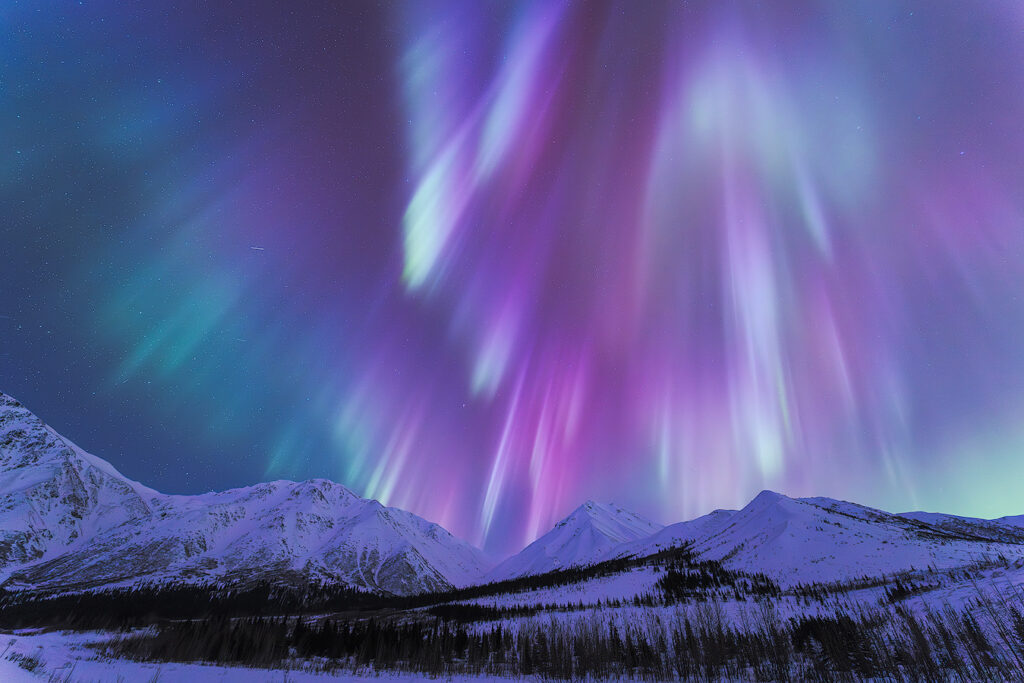
The colors of the northern lights are determined by which gas is excited, at what altitude, and how energetically solar particles react with it. The aurora borealis and aurora australis produce different colors because different gases emit different wavelengths — this is how aurora colors form. Understanding the northern lights altitude map changes how you read every display. The different colors of the aurora are produced by the solar wind reacting with different gases at various altitudes — each hue is determined by atmospheric composition. The sun’s activity fluctuates as part of an 11-year solar cycle, making some years more active than others. Understanding this map changes how you read every aurora display — and why northern lights displays vary so much.
Want to see them for yourself? Get the free season calendar.
Every viewable week from August 2026 through April 2027 — moon phases, dark hours, and the strongest nights to plan around, plus a 16-page field guide on reading the aurora forecast and what the lights really look like to the naked eye. From a native Alaskan guide. Free.
Where the Aurora Actually Happens: The Thermosphere
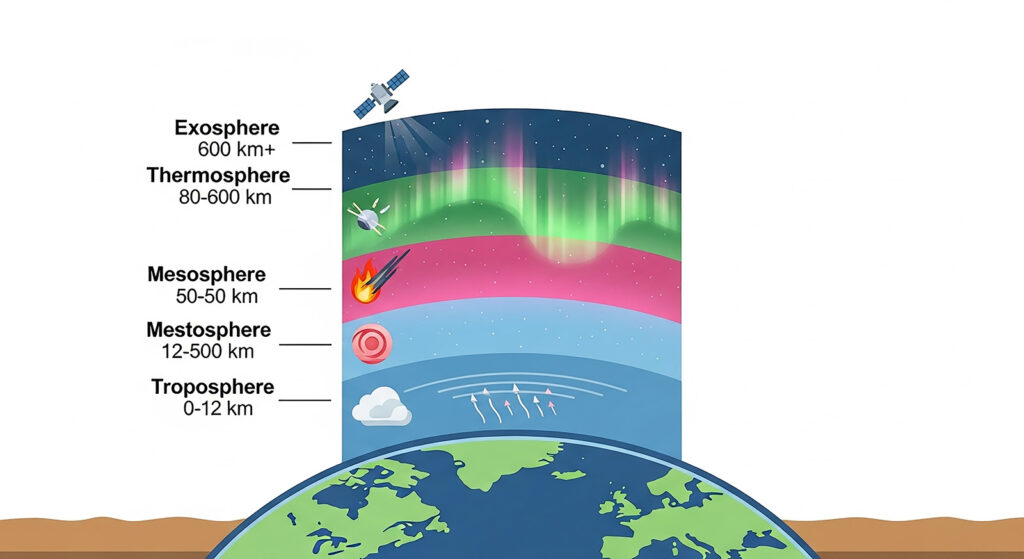
The aurora borealis primarily occurs in the thermosphere — Earth’s atmospheric layer stretching from about 80 to 600 kilometres above the surface. High concentrations of oxygen molecules are present at these altitudes, along with nitrogen and other gases, at densities where solar particles react with each gas molecule. Trace amounts of gases such as neon, helium, and hydrogen also contribute. The principles of quantum mechanics govern the photon-emission transitions, determining which wavelengths of light are emitted and which auroral colors appear.
Why the Thermosphere and Not Lower?
Earth’s magnetic field funnels the solar wind — electrically charged particles — toward the polar regions. As the solar wind descends, it interacts with individual atoms and molecules — solar particles react with atmospheric gases, particularly atmospheric gases. Below about 80 kilometres the atmosphere is too dense; the solar wind is absorbed before causing widespread light emission. Above 300km the atmosphere is too diffuse. The thermosphere is the sweet spot: energetic particles of the solar wind sustain light emission here, where atmospheric composition enables the aurora. Sufficient light emission for viewing requires the solar wind to collide at thermosphere densities — below that the light emission is too diffuse, above that there is not enough light emission at all.
The Color Map: What Each Atmospheric Layer Produces
The different colors in aurora displays are not random — each color is a signature of a specific atmospheric layer. Different gases at different altitudes emit different colors when excited by incoming solar particles. Understanding which different colors appear means reading which layers are active.
100–150km: Atomic Oxygen — The Green Layer
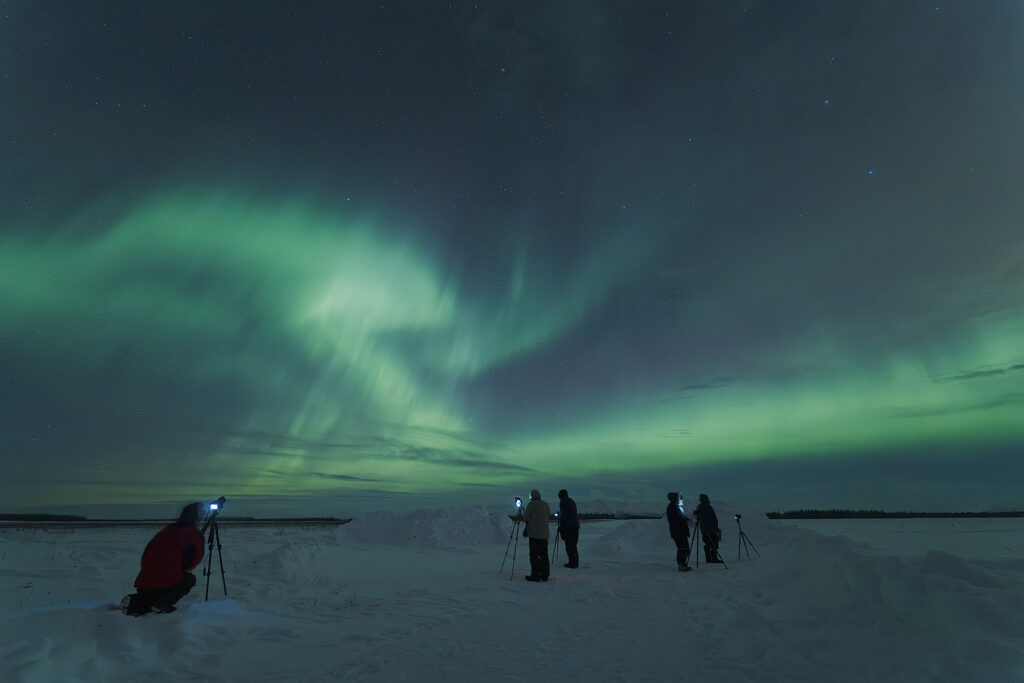
Green auroras are the most common northern lights color — the signature of northern lights activity. At 100–150 kilometres, solar particles collide with high concentrations of oxygen molecules — the solar wind strikes the gas directly. These excited atoms emit a green photon at 557.7 nanometers as atoms return to their ground state — the specific electron transition atomic oxygen undergoes at this altitude. The green light of the aurora is emitted as oxygen atoms — excited atoms returning to rest — relax from their excited state, which takes almost a whole second, making oxygen atoms especially efficient aurora emitters. Green is the baseline color of most aurora displays because this altitude band is active during most solar activity events. Green auroras are most visible to the naked eye because the human eye is most sensitive to this wavelength.
Above 200km: Atomic Oxygen — The Red Layer
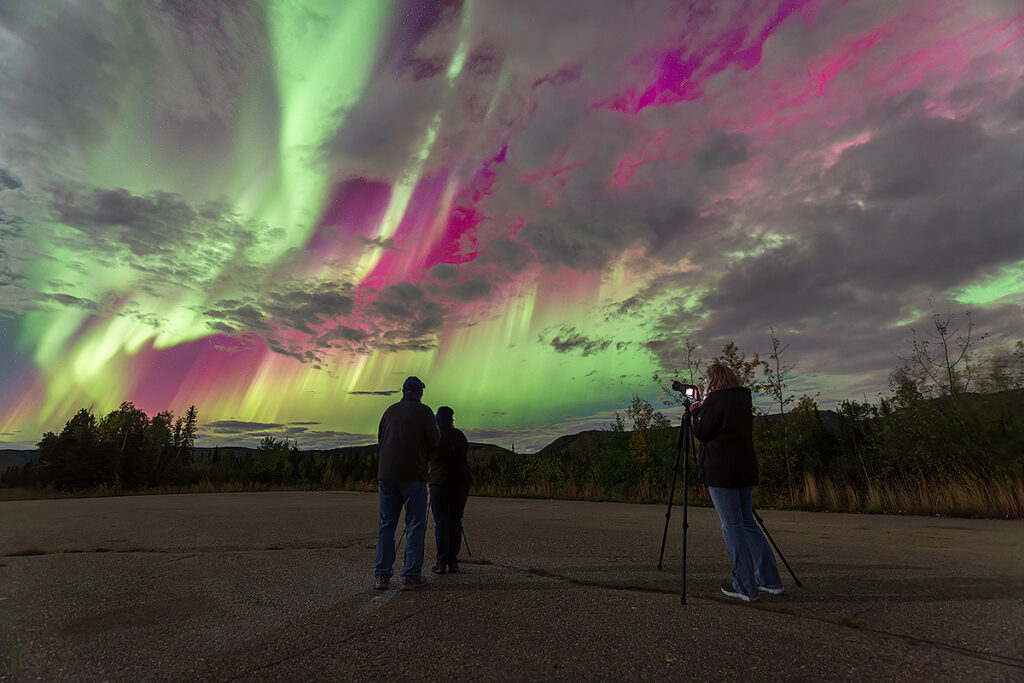
Higher up, above 200 kilometres, atomic oxygen is excited at a higher frequency — oxygen atoms at this altitude produce a spectacular red aurora when they are reached by the solar wind. The atom remains in its excited state longer here — less likely to collide with other atoms and lose its stored energy. Eventually the atom releases its excitation at a different level, emitting light at approximately 630 nanometers — into the red part of the spectrum. This is a forbidden transition that only occurs efficiently in low-density conditions. Red auroras require intense solar activity — usually Kp 5 or higher — when solar particles collide with oxygen at these higher altitudes. Making reds visible in the sky requires intense solar activity, making red one of the rarer auroral colors.
Below 100km: Ionized Nitrogen — The Blue and Purple Layer
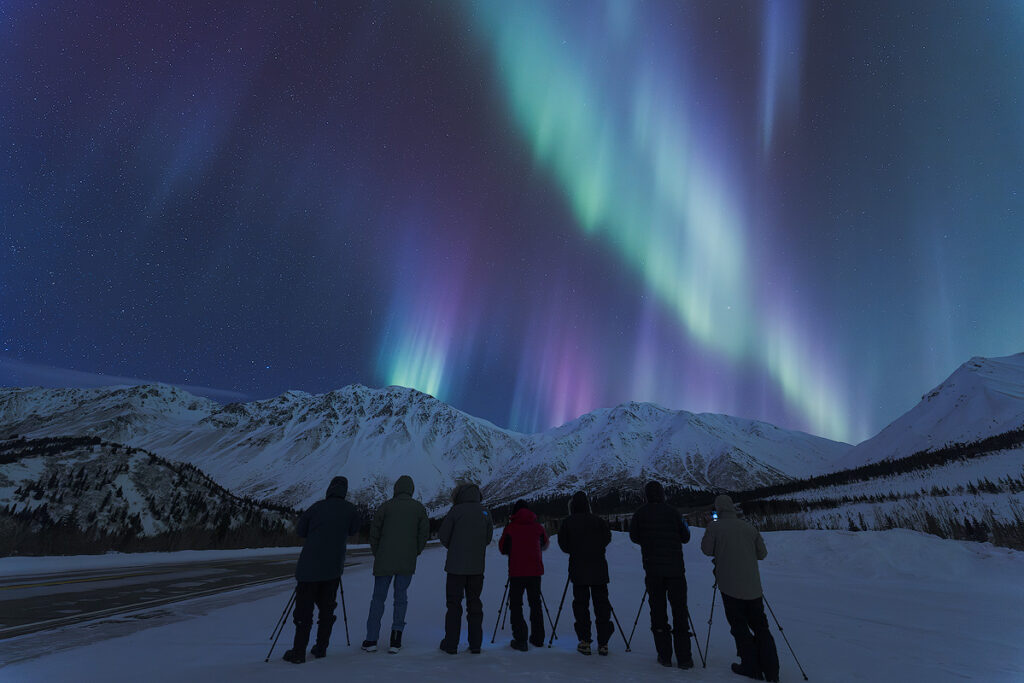
At low altitudes, typically below 100 km, the solar wind encounters nitrogen molecules (N₂). When this molecular nitrogen absorbs the incoming solar wind, they become ionized and excited, emitting photons at wavelengths around 391 and 428 nanometers — violet and purple. Blue and purple auroras appear during high solar activity when the solar wind reaches nitrogen at low altitudes. Blue and purple fringing signals Kp 5 or above — the solar wind collides deep in the atmosphere during large storms. When charged particles collide here, nitrogen emits blue-violet.
Why Pink and Magenta Appear Near the Horizon
Pink and other colors arise from overlap zones. A pink or magenta appearance arises from ionized nitrogen emissions — blue and violet — mixing visually with red emissions from high-altitude atomic oxygen. Other colors like yellow and magenta result from similar mixing during intense auroral displays. Making reds visible at these lower mixing zones requires intense solar activity. Pink occurs when a high-energy solar storm drives both emissions simultaneously. Yellow and pink auroras are associated with high solar activity and result from a mixture of red auroras with green or blue auroras.
Reading a Multi-Color Display in Real Time
The aurora’s altitude-color map is a live readout of which atmospheric layers are producing light emission above you. Green alone means moderate solar activity — Kp 2–4. A blue-violet fringe at the base means nitrogen below 100km is excited at Kp 4–5. A red crown above the green curtains means solar particles are reaching atomic oxygen above 200km at Kp 5–7 — check the aurora forecast before you head out to know which color layers are likely to be active on any given night. At solar maximum, intense auroral displays of all three colors occur simultaneously — green, red, and blue-violet. Solar maximum years consistently produce the most spectacular multi-color northern lights.
How This Changes Your Photography
Cameras capture aurora colors more completely than the naked eye and human eye because long exposures accumulate faint photons of light — why northern lights look different in photos than in real life explains the full biology and physics behind that gap. The light from each altitude band — green light at 557nm, red light at 630nm, blue-violet light from nitrogen — all accumulate on the sensor simultaneously. The naked eye perceives green most easily; cameras reveal the violet and red layers the human eye barely registers. Aurora forecasts are often visible based — estimating aurora likelihood based on geomagnetic activity. Understanding which atmospheric layer produces which colour tells you exactly which settings to prioritise for each type of emission — the full aurora photography guide covers ISO, shutter speed, and white balance for every Kp level.
Fairbanks: The Classroom Under the Oval
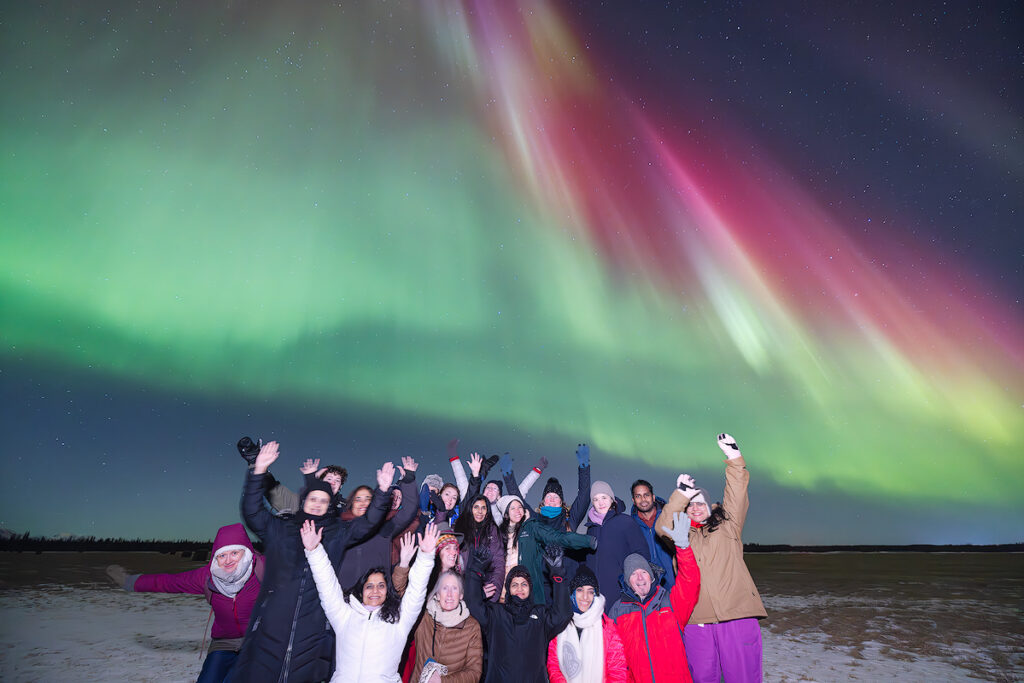
Fairbanks, Alaska, is located at 64.8° N latitude, directly beneath the aurora oval. The atmosphere above Fairbanks spans the full aurora color range — unlike locations further south where northern lights appear as low arcs against the night sky, Fairbanks observers see the aurora overhead. The upper edge of the red oxygen layer, the green curtains at mid-altitude, the violet-blue nitrogen fringes at the base — all visible simultaneously during intense aurora nights. This overhead perspective makes Fairbanks one of the best natural classrooms for the altitude-color science of the aurora.
What layer of the atmosphere does the aurora occur in?
The aurora primarily occurs in the thermosphere, the upper atmosphere layer extending from about 80 to 600 kilometres above the surface. The most frequent and vibrant aurora displays occur between 100 and 150 kilometres. During intense geomagnetic storms, auroral activity can extend to higher altitudes — sometimes up to 300 kilometres or more.
Why does the aurora only happen at the poles?
Auroras are predominantly seen near the north and south poles due to Earth’s field. The field lines converge at the poles, guiding the solar wind into the thermosphere at those regions. At lower latitudes, Earth’s field deflects most of the solar wind before it can penetrate to produce the aurora, forming the auroral oval around the poles. Auroras occur in the northern hemisphere as aurora borealis and at the south pole as aurora australis and the southern lights.
Does the aurora happen below the clouds?
No. Clouds form in the troposphere up to about 12 kilometres. The aurora occurs in the thermosphere at 80 to 300 kilometres — entirely above any weather system. If skies are overcast you see the cloud base, not the aurora. The aurora always occurs far above any weather clouds. Aurora forecasts account for cloud cover because overcast skies block the view of the atmosphere where auroras occur — the primary obstacle to seeing auroras.