
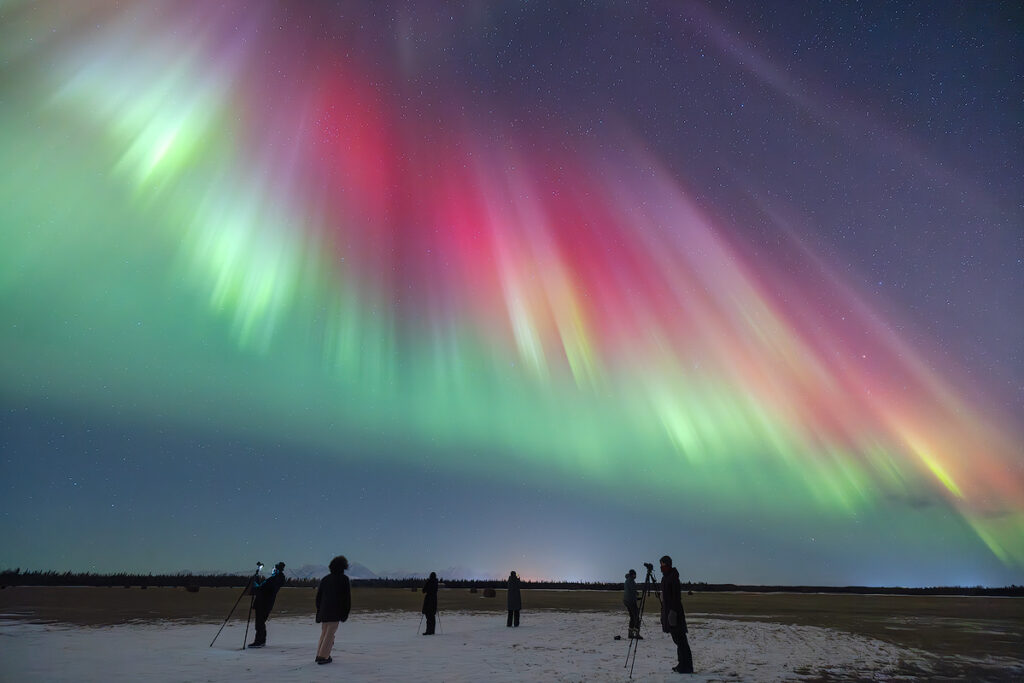
Northern lights Fairbanks — what you see in person ranges from a faint green glow on the horizon to a full-sky explosion of colour, and almost always looks different from what photographs led you to expect. What you see depends on Kp level, cloud cover, and dark adaptation. As a Fairbanks aurora guide who has watched thousands of guests see the northern lights for the first time — many on their bucket list — I can tell you the gap between expectation and reality is the most common source of surprise, in both directions.
Let Me Tell You What I Wish Someone Had Told Me Before My First Guest Season
Not gonna lie — the first time I watched a guest walk inside after a northern lights display, shrug, and say “I thought it would be bigger,” it stung. She’d seen magazine photos. She’d watched Reels. She’d expected the sky to light up on cue. What she saw was a pulsing green northern lights display rolling across the northern sky — gas in Earth’s atmosphere glowing from solar particles. Kp 3. A perfectly active display. Beautiful, if you knew what you were looking at. Disappointing, if you’d been measuring it against a 25-second camera exposure running in your head.
That moment is why I write posts like this. Setting expectations isn’t about lowering the bar — it’s about making sure guests understand what the northern lights actually are, so when the lights appear, they recognize them. And when it really goes off, they’re ready.
What to Expect: What the Northern Lights Actually Look Like in Person
The aurora borealis is a natural light display seen in high-latitude regions of the northern hemisphere — just as the aurora australis appears near the south pole in the southern hemisphere. While photographs often capture vibrant, explosive colors and dramatic movements, what you see with your naked eye is often more subtle, yet equally mesmerizing. Imagine a soft, ethereal green glow painting the darkness overhead, occasionally morphing into undulating curtains or arcs that shimmer and dance. While extreme displays can be incredibly dynamic, a typical evening under the northern lights in Fairbanks might present a beautiful, steady band of green light gracing the north horizon, a testament to the incredible forces at play far above us. The most vivid northern lights displays are often seen in the far north — from Denali National Park north toward the Brooks Range, optimal conditions for seeing the northern lights exist across Interior Alaska.
The Camera Lie Nobody Talks About
Every viral northern lights photo you’ve seen was taken with a wide-angle lens, a tripod, and an exposure between 10 and 30 seconds. In those 15–25 seconds, the camera collects every photon that hits the sensor. The result is a vivid, saturated image that can make a mild Kp 2 display look like the northern sky is actively on fire.
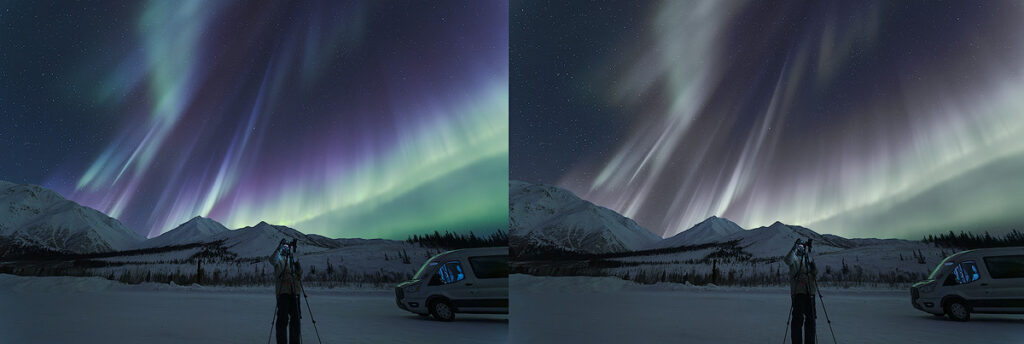
Your eyes don’t work that way. Your retina processes light in real time. The northern lights you see with the naked eye are real — but it’s not Instagram. It’s usually a more muted, moving green band or arc, often with a faint violet fringe at the top edge. When it gets active — Kp 5 and above — the color and brightness snap into full view even without a camera. But on a moderate display, what you see and what a camera records will look very different.
The Kp Scale: What It Actually Means for What You’ll See
The Kp index is a planetary geomagnetic activity scale from 0 to 9. Here is what each Kp level typically means for seeing the aurora borealis from the ground in Fairbanks:
Kp 0–1: A faint green arc on the northern horizon — look north and you may catch a pale northern lights shimmer. Cameras show this clearly but your eyes may miss it without dark adaptation. The northern parts of Alaska, Canada, and Scandinavia see these subtle northern lights most frequently.
Kp 2–3: A clear green band, with some subtle movement. This is easily visible to the naked eye. Most guests see the northern lights at Kp 2–3 on a typical Fairbanks evening — a real display, not a faint hint. Seeing the northern lights even at this level is something most people never experience.
Kp 4–5: Active curtains with rapid movement. The colors, primarily green, become much more pronounced without a camera. Seeing the northern lights at Kp 4–5 is what most guests describe as the real thing. Seeing the northern lights at Kp 6+ is what changes people. See the northern lights once at this level — full aurora overhead — and the memory stays forever.
Kp 6+: A full-sky aurora display with rapid movement, overhead activity, visible reds and purples — rare but transformative.
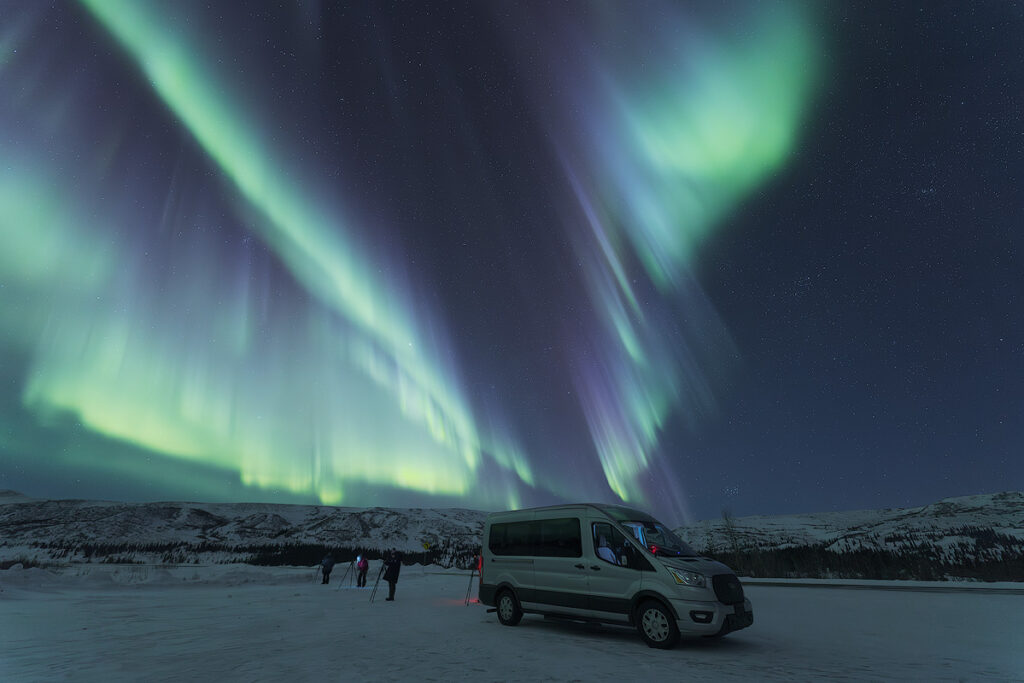
Most aurora borealis tours in Fairbanks operate on Kp 2–4 evenings. Most aurora borealis tours in Fairbanks operate on Kp 2–4 evenings — learn how to read the northern lights forecast so you know what to expect before heading out each night. Experienced aurora hunters know that’s not a failure — that’s the baseline reality of living under one of the most active auroral zones on Earth. The northern lights are almost always doing something, but its visibility is dictated by a trifecta of factors.
The Three Variables That Actually Determine What You’ll See
Geomagnetic Activity (the Kp Index)
The Kp Index quantifies disturbance in Earth’s magnetic field — higher values mean more intense geomagnetic storms and more widespread northern lights. In Fairbanks, at 65° N directly beneath the auroral oval, active evenings happen roughly 243 out of 365 days per year. The solar wind — charged particles streaming from the sun — drives this. These charged particles — When particles from the sun collide with atmospheric gases in Earth’s upper atmosphere — and they do, constantly —, they release visible light as they return to their ground state. The sun’s solar cycle drives phenomena like solar flares, coronal mass ejections (CMEs), and coronal holes, all of which send solar wind toward Earth. The solar cycle moves between solar maximum and solar minimum, but in both phases the magnetic field channels activity into the auroral oval. Fairbanks is consistently positioned to see the northern lights. The true challenge lies in the other two variables.
The solar cycle moves between solar maximum—peak activity—and solar minimum, a quieter phase. Throughout both phases, the magnetic field shapes where northern lights appear on Earth. Understanding that Fairbanks sits directly under the auroral oval means the potential for a show is consistently high. The true challenge lies in the other two variables.
Cloud Cover (the Real Enemy)
Bad weather is the main obstacle for seeing the northern lights — even with perfect geomagnetic conditions. Fairbanks averages 14–22 cloudy days per month during the northern lights season (August through April).
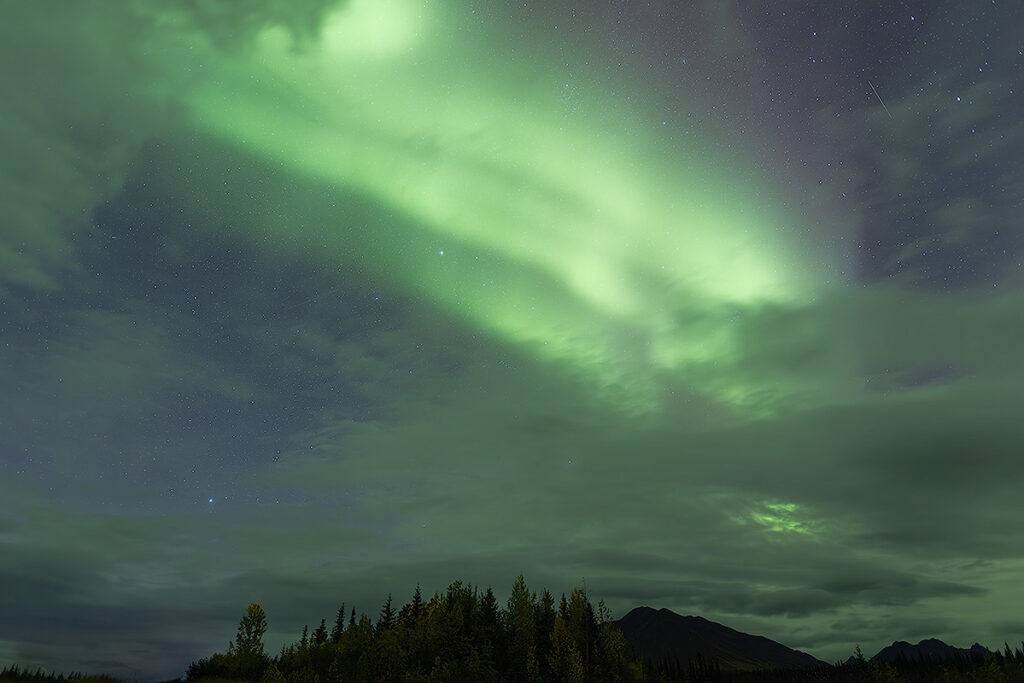
A single overcast night on a three-night northern lights trip eliminates a third of your viewing window. It’s not because the northern lights are unreliable — it’s because Alaska weather is. Even with a high Kp forecast, cloud cover means zero visibility from the ground. Booking 5–7 evenings gives you clear skies often enough to catch a real display. Booking 5–7 evenings gives you clear skies often enough to catch a real display — see the full night-by-night probability breakdown to understand exactly how the odds change with each additional night.
Light Pollution and Your Eyes
Even with clear skies, your ability to see the northern lights depends on dark adaptation — your eyes take 20–30 minutes to fully adjust. Stepping outside for 90 seconds won’t cut it. Our viewing locations are chosen to minimise light pollution. Driving 15 minutes out of Fairbanks city centre, away from city lights, dramatically changes what you can see.
What Guests Tell Me They Weren’t Prepared For
The Cold
You’re standing outside in Interior Alaska. Temperatures regularly drop below -20°F in Interior Alaska, sometimes far lower. I’ve watched incredible northern lights displays end early because guests weren’t prepared. Merino wool base layer, insulating mid-layer, windproof outer shell, boots rated to -40°F, thick mittens — the complete northern lights packing list for Alaska covers every item and why it matters at -20°F. That combination is the difference between a 20-minute aurora glimpse and a three-hour viewing session.
The Waiting
The northern lights are a natural phenomenon — northern lights don’t perform on schedule. Some of the best displays I’ve guided began after 1 AM.
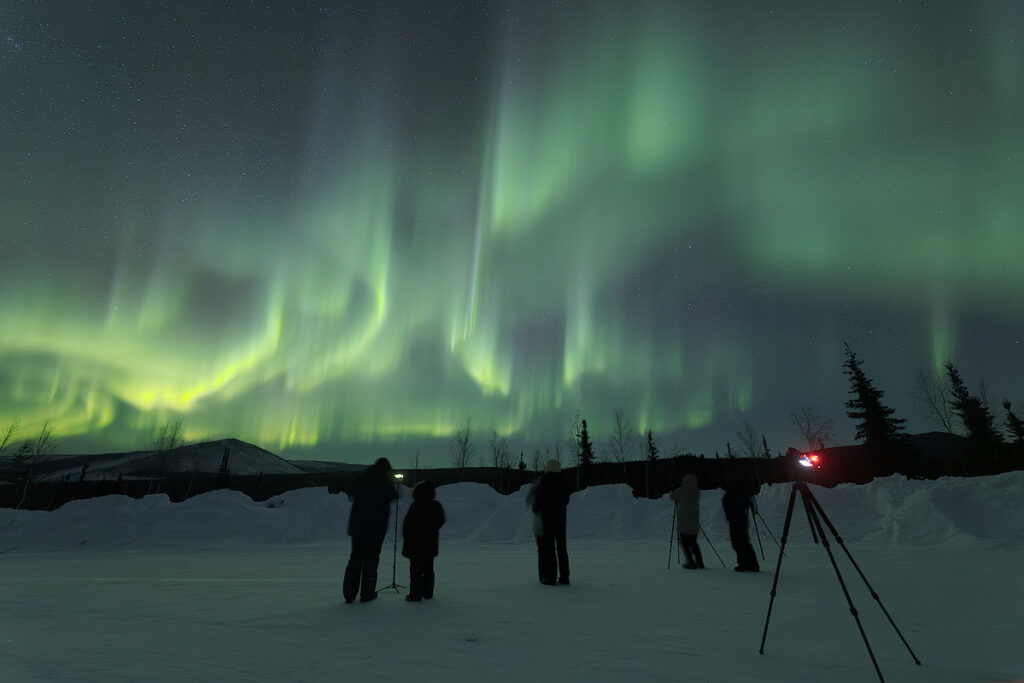
Aurora hunters who stay out on active nights, stay warm, and stay patient are the ones who see the overhead corona. A single northern lights night at Kp 6+ is worth three mild northern lights nights. Embrace the stillness and the cold — both are part of the aurora experience — the chance to see the northern lights at peak activity comes to those who wait.
How Good the Photos Will Be
The flip side of the camera lie: guests who’ve never done long-exposure photography are genuinely stunned by how vivid aurora looks on the first clear evening. The image on their LCD screen looks nothing like what their eyes saw — and usually, it’s far more vivid. Understanding why the northern lights look different in photos than in real life helps you interpret both experiences accurately.
How Face The Outdoors Approaches Expectation-Setting
Every pre-trip call at Face The Outdoors includes a realistic briefing: the Kp forecast for your dates, what to pack for Arctic Circle conditions, and what a genuine northern lights viewing session looks like versus what photographs suggest. We don’t promise guaranteed sightings — we promise correct positioning, local expertise, and enough nights to absorb weather. As Michael Schultz puts it: “The guests who leave happiest came knowing the northern lights are a natural phenomenon, not a guaranteed spectacle. They stayed patient, and nature delivered.”
Frequently Asked Questions
How long do the northern lights last each night?
A single substorm on any given night typically runs 15–45 minutes. On a highly active night (Kp 5+), multiple aurora substorms can occur across a 4–6 hour window. On quieter evenings the northern lights may be faint but present for hours as a steady arc. Duration is driven by solar storm intensity and space weather conditions.
Is seeing a faint aurora worth it?
That depends entirely on your expectations. A Kp 2 display won’t match the photographs — but to see the aurora borealis at any activity level is to witness something most people on Earth never do. If you understand what you’re looking at – the science behind the glow in Earth’s atmosphere — when particles from the sun collide with atmospheric gases, that collision produces the light you see – even a quiet viewing session is remarkable. If you came expecting the magazine cover, a quiet display can feel underwhelming. That’s the whole point of this post: to bridge that gap and help you appreciate every level of the aurora’s display.
Why didn’t I see the northern lights even though the forecast said active?
Cloud cover is the most common culprit. Even with a high KP Index forecast indicating strong solar activity, overcast skies mean zero visibility from the ground. The second most common reason is timing. Many guests may step outside for just 10 minutes at 10 PM and assume nothing happened, not realizing that the most active display ran from 12:30 AM to 2 AM. It’s also possible that the aurora forecast was for a slightly different region, or that the geomagnetic storm was more localized than anticipated. Understanding space weather forecasts — not just the Kp number — helps. Aurora hunters who track real-time magnetometer data often see the northern lights on evenings that casual viewers write off.
Ready to Plan Your Northern Lights in Fairbanks Trip?
The most important decision for seeing the northern lights isn’t which date — it’s how many nights. Seeing the northern lights once only makes you want to see them again. The aurora borealis is remarkably consistent in Fairbanks: the auroral oval and Earth’s field channel solar wind from the far north overhead. Alaska weather is not consistent. Give yourself 5–7 evenings — northern lights trips of this length achieve aurora sightings on 93–98% of attempts.
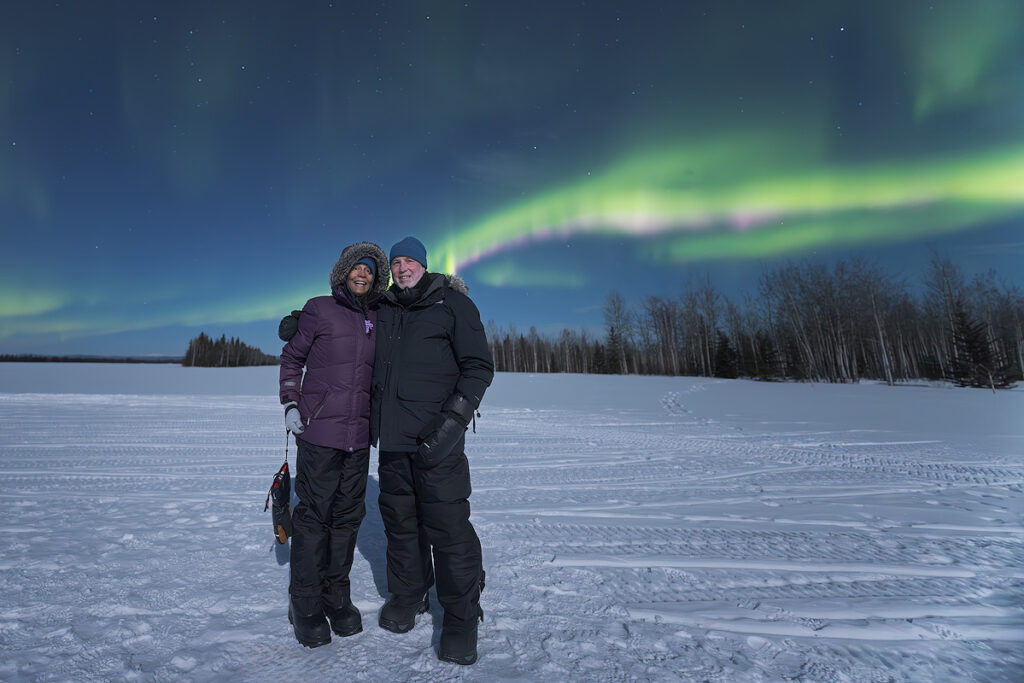
The northern lights season runs late August through mid-April, once the midnight sun retreats. Geomagnetic activity peaks around the spring and autumn equinoxes — February and March offer the fewest cloudy nights per month, with the longest dark night sky windows and strongest aurora activity. Avoid a full moon if possible. Unlike northern Norway or the Lofoten Islands to the east, Interior Alaska’s continental climate gives Fairbanks more clear nights. Even further south in Alaska you don’t get this consistency. During strong geomagnetic storms the northern lights reach further south, but Fairbanks — south of the Brooks Range, the south end of the auroral sweet spot — is where you see them reliably. Borealis Basecamp and Face The Outdoors both operate in the same aurora-viewing dark-sky zone north of the city.